
Restaurant Wall Branding Ideas: A Practical Guide for BrAMPT
Explore restaurant wall branding ideas for Brampton, including UV wall printing, murals, wayfinding, mockups, surface prep, and off-hours installation.
Last updated: October 2026
Key takeaway:The most effective restaurant wall branding ideas combine one memorable feature wall with supporting patterns, storytelling, and wayfinding that fit the floor plan. For Brampton restaurants, UV wall printing can deliver detailed, durable graphics during an organized off-hours installation, provided the artwork, lighting, wall condition, and guest flow are reviewed before printing.
Last updated: October 27, 2026
Restaurant walls influence how guests understand a venue before the first dish arrives. A well-planned wall can communicate cuisine, origin, atmosphere, and quality while giving guests a natural place to pause, photograph, or find their way through the space.
The strongest restaurant wall branding ideas are not simply decorative. They connect the visual identity outside the restaurant with the interior experience, support the service layout, and remain practical around seating, cleaning, lighting, and future changes. Ink Blend helps restaurants and cafés turn prepared interior surfaces into branded environments through UV wall printing, custom murals, surface graphics, and large-format printing.
DecisionPractical starting point Primary visualChoose one feature wall that guests can see from a meaningful arrival or seating position. Supporting graphicsUse patterns, ingredient illustrations, or subtle brand details where they reinforce the room without competing with food. Production choiceConsider direct-to-wall UV printing for precise artwork on smooth, prepared surfaces. Installation planApprove scaled mockups, coordinate surface preparation, and schedule printing around service. Local planningAccount for plaza access, shared corridors, cold weather, and Brampton dinner peaks.- What makes restaurant wall branding work
- Restaurant wall branding ideas to consider
- Choosing a wall-printing method
- The process from wall photo to installation
- Accessibility and wayfinding considerations
- Planning an installation in Brampton
- Frequently asked questions
What Makes Restaurant Wall Branding Work?
Effective branding begins with a job for each wall. A feature wall may establish the mood and become a photographable backdrop, while a smaller graphic near the queue may clarify ordering or repeat a recognizable brand motif. When every surface tries to be the focal point, the room can feel noisy and the food, menus, and staff lose visual priority.
Start by considering what guests see from the entrance, host stand, bar, booths, and ordering line. A design that looks compelling in isolation may be hidden by a banquette, interrupted by a service door, or cropped by a camera angle. Scaled mockups make these conflicts visible before artwork is approved.
Define the story before choosing the artwork
A restaurant can use its walls to explain an origin, ingredient, technique, neighbourhood connection, or point of view. A café might use restrained botanical forms and a short phrase, while a grill or bakery might show tools, ingredients, or process illustrations. The concept should support the restaurant’s existing menus, packaging, uniforms, and signage rather than introduce an unrelated visual language.
Design for lighting, photography, and distance
Colours change under warm pendants, daylight, and cooler light spilling from service areas. Fine type can disappear across a room, while high-contrast patterns may become distracting at close range. Review important colours and text at the distance guests will experience them, and leave enough negative space for photographs that include people, tables, or food.
For a production reference, commercial interior branding services can help connect wall artwork with the wider visual system. The aim is not to cover every available surface; it is to create a consistent experience with a clear hierarchy.
Restaurant Wall Branding Ideas to Consider
The right combination depends on the restaurant’s concept, floor plan, and level of visual activity. Most projects benefit from one primary statement and several quieter supporting elements.
1. A signature feature-wall mural
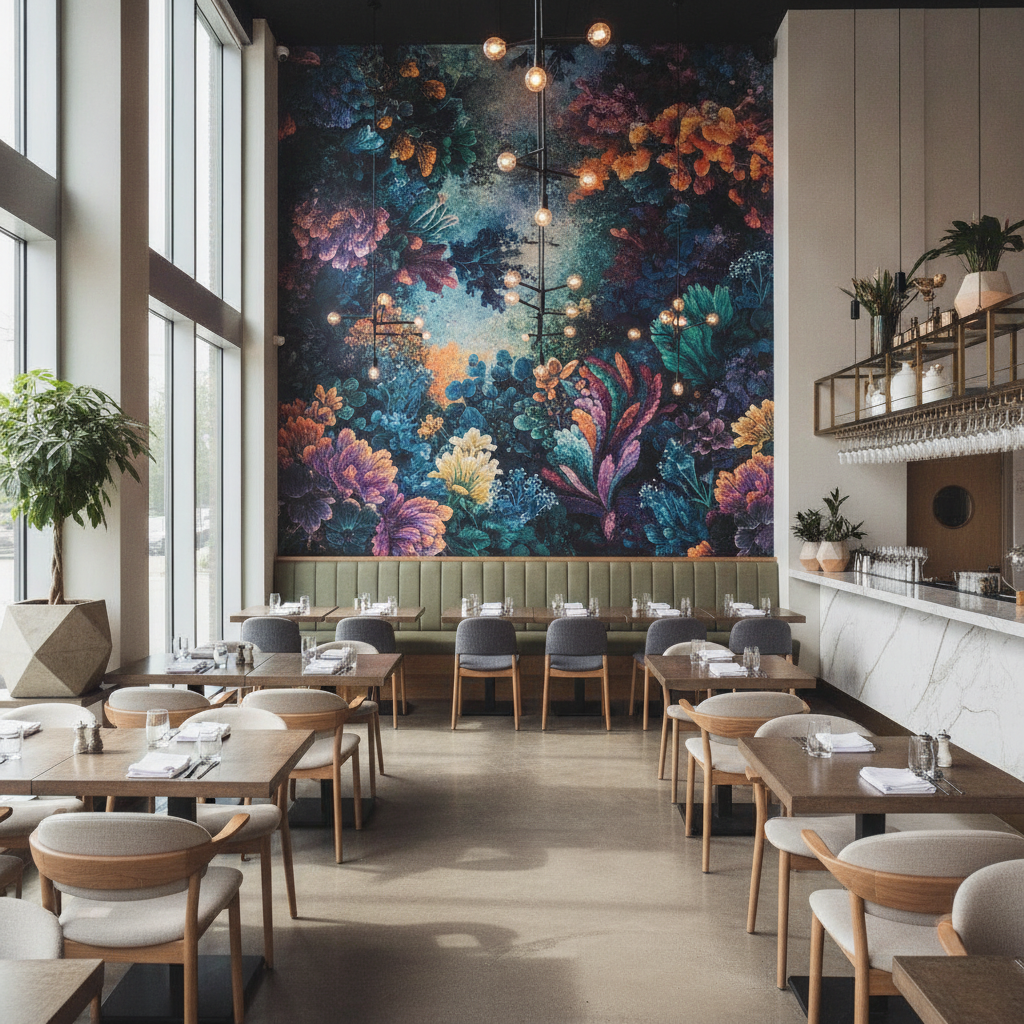
Place a bold composition behind the host stand, main seating area, bar, or another location with a strong sightline. The artwork could use abstract forms, botanical shapes, a city reference, an ingredient landscape, or a scene connected to the restaurant’s origins. Keep essential details away from areas likely to be hidden by furniture or replaced fixtures.
A feature wall should work both as part of the room and as a background in guest photographs. That usually means balancing recognisable brand colours with enough uncluttered space around faces, tables, or plated food. Custom wall murals can suit restaurants looking for a large visual story with a more immersive feel.
2. A repeatable brand pattern
Repeating icons, ingredient shapes, utensils, tiles, or geometric forms can extend the brand without relying on a large logo. Use the pattern on a queue wall, booth backs, a corridor, or a transition between dining zones. A restrained scale and controlled colour palette help the pattern support the room rather than compete with menus.
3. Ingredient and technique illustrations
Line drawings can show signature ingredients or steps such as roasting, baking, grinding, fermenting, or hand preparation. This approach gives guests something to discover while reinforcing what makes the menu distinctive. Keep strokes and labels large enough to remain legible under the actual lighting and from the intended viewing distance.
4. Photo-led origin storytelling
Archival family photographs, local scenes, farms, markets, or images of the team can make a restaurant feel personal. Use a consistent treatment so a collection feels intentional rather than like an assortment of framed images. Before using photographs, confirm ownership and permissions, and check that important faces or captions will not be covered by furniture or future equipment.
5. A culture and community wall
A planned display can introduce staff, celebrate milestones, acknowledge suppliers, or reflect the neighbourhood. Build update zones into the design if names, dates, or seasonal information will change. This keeps the wall useful over time and reduces the chance that a full mural must be replaced for a small content update.
6. Wayfinding and order-flow graphics
Colour bands, icons, directional cues, and concise labels can help guests understand where to order, collect food, wait, or find amenities. These elements should be noticeable without looking like temporary signs. Place them where decisions occur, keep wording brief, and avoid positioning essential information where queues, doors, or displays will block it.
For most restaurants, a practical combination is one high-impact hero wall, one quieter brand pattern, and clear but restrained order-flow cues. This creates a memorable environment while preserving the visual calm needed for menus, food presentation, and conversation.
Which Wall Branding Method Fits a Restaurant?
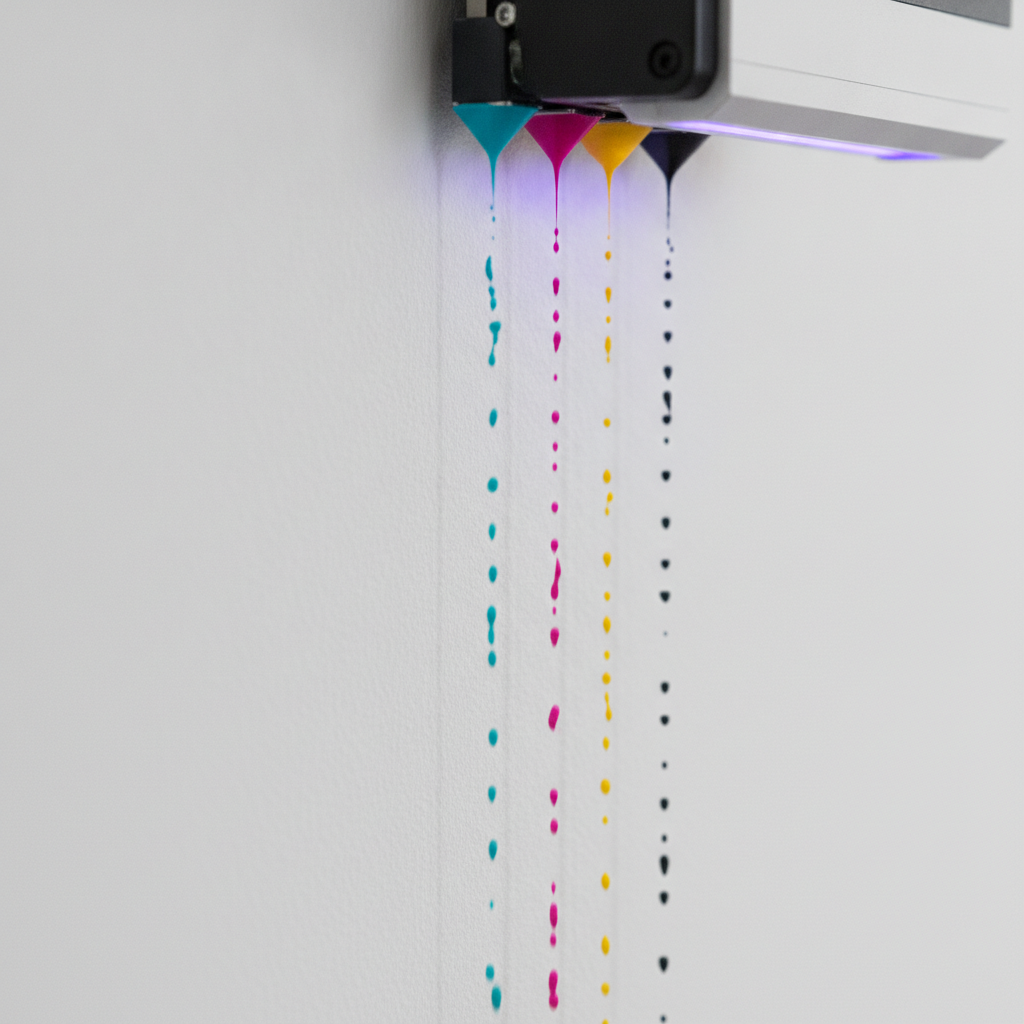
Production should follow the design brief and the building’s constraints. Direct-to-wall UV printing is useful when artwork needs crisp detail, accurate placement, and an efficient on-site installation. Hand-painted murals create visible brush texture and an artisan character, while wallpaper or film can be appropriate when removability or panel-based installation matters.
MethodUseful whenPlanning considerations Direct-to-wall UV printingArtwork includes detailed graphics, patterns, photography, or precise logos.Requires a smooth, sound, clean, prepared surface; artwork and clearances should be approved in advance. Hand-painted muralThe concept depends on brushwork, texture, or a visibly handmade finish.On-site work may take longer, and the final appearance depends on the artist, surface, lighting, and protective finish. Wallpaper or filmThe project requires panels, removability, or a finish that is not printed directly on the wall.Seams, edges, substrate condition, and future removal should be discussed before selection.UV wall printing is not a substitute for surface preparation. Fresh repairs, flaking coatings, heavy texture, grease, or uneven sheen can affect the result. When the wall is smooth and fully cured, direct printing can provide detailed graphics that are ready for the next stage of the restaurant schedule once the ink has cured.
How the Professional Process Works
A reliable process reduces design changes, installation surprises, and disruption to service. The project should move from the restaurant’s goals to the physical conditions of the wall, rather than beginning with a generic artwork template.
1. Share photos, measurements, and the operating context
Provide wall photos, approximate dimensions, ceiling height where relevant, furniture locations, outlet positions, doors, sprinklers, and any access restrictions. Explain when the room is busiest and whether the wall is near food preparation, customer seating, or a high-contact route.
2. Develop the concept and scaled mockup
The mockup should show the design in the actual room or a close visual approximation. It should account for cropping, sightlines, furniture, clearances, lighting, and the relationship between the feature wall and nearby surfaces. If colour is especially important, review critical hues under the restaurant’s lighting rather than relying only on a screen.
3. Approve artwork and responsibilities
Confirm the final dimensions, artwork, logo treatment, text, margins, and installation area. Establish who will patch, sand, paint, clean, and confirm that the surface is cured. Written responsibilities prevent a printer from arriving while another trade is still creating dust or changing the wall finish.
4. Prepare and protect the site
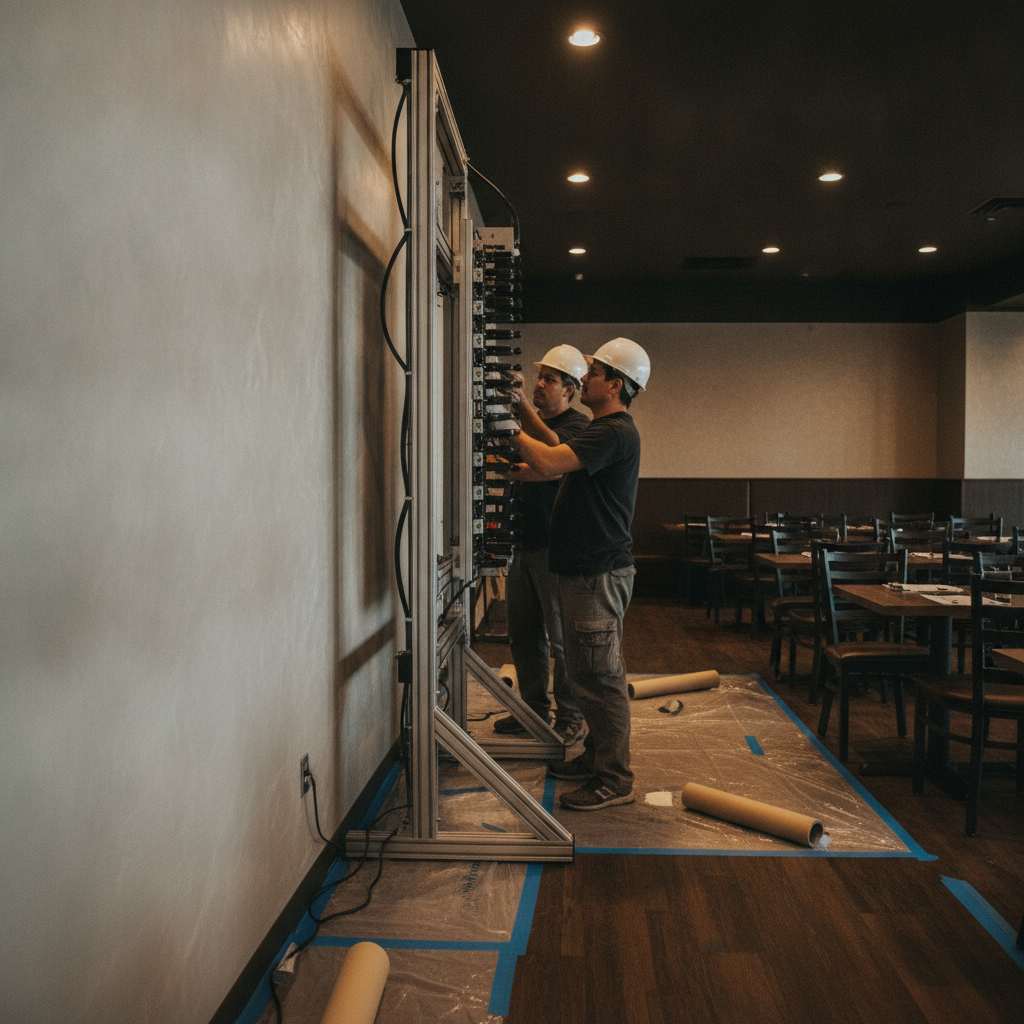
Smooth, sound, clean paint generally provides the best starting point. Floors, furniture, equipment, and nearby surfaces should be protected, and the team should have a clear route from the access point to the wall. Shared corridors and plaza rules may require advance coordination.
5. Print during an agreed off-hours window
Once the rig is aligned and the wall is ready, the artwork is printed to the approved area. UV ink cures under the printer’s lamps as it is applied, which can help reduce the drying window associated with some other finishing methods. The actual schedule depends on wall size, artwork, access, preparation, and the project scope.
For projects connected to a larger renovation, these Brampton restaurant build-out planning notes can help coordinate painting, inspections, dust-producing work, and final branding.
Accessibility and Wayfinding Considerations
Wall branding that includes customer-facing information should be planned alongside accessible communication. Contrast, legibility, viewing height, placement, and the difference between decorative artwork and essential directions all matter. A beautiful graphic is not a replacement for required signage or accessible information.
Review current requirements with the appropriate professional or authority for the project. Ontario’s official accessibility guidance for businesses and non-profits is a useful starting point, but the applicable legislation, building requirements, and site conditions should govern final decisions.
Keep essential directions easy to find
Use short wording, strong contrast, consistent symbols, and predictable placement for directions to ordering, collection, washrooms, exits, or accessible routes. Do not hide critical information inside a busy mural or place it where a queue will routinely block it. Decorative typography can support the concept, but functional information should remain immediately understandable.
Planning Restaurant Wall Branding in Brampton
Brampton restaurants often operate in busy plazas, shared commercial buildings, and compact interiors where access and scheduling require careful coordination. Dinner peaks can make daytime installation impractical, while shared service corridors may require advance arrangements with property management. Confirm loading, parking, elevator, security, and after-hours access before the print date.
Coordinate printing after sanding, patching, and other dust-producing work. During colder weather, exterior-facing walls and recently painted surfaces may need suitable conditions and full curing before artwork is applied. A smooth, cured surface improves both the visual finish and the practicality of routine cleaning.
A Brampton installation checklist
- Measure the complete wall and note doors, outlets, sprinklers, trim, furniture, and equipment.
- Confirm whether the landlord or property manager has access, protection, or working-hour requirements.
- Schedule wall preparation early enough for paint and repairs to cure fully.
- Reserve a clean route for equipment and protect floors and nearby dining surfaces.
- Choose an off-hours window that leaves enough time for alignment, printing, inspection, and site cleanup.
- Review the finished wall under the lighting guests will actually experience.
Ink Blend’s workflow centres on discovery, visual direction, mockups, approvals, and professional printing. That structure is particularly useful when a restaurant must coordinate branding with staff schedules, contractors, landlords, and the next service period.
Frequently Asked Questions
What are the best restaurant wall branding ideas for a small dining room?
A small restaurant usually benefits from one clear focal wall, a restrained repeat pattern, and concise wayfinding rather than several competing murals. Use sightlines from the entrance and seating to choose the wall, then leave enough negative space so the room does not feel crowded. A scaled mockup can show whether furniture, menus, or queues will obscure the design.
Is UV wall printing suitable for restaurant interiors?
UV wall printing can suit restaurant interiors when the substrate is smooth, sound, clean, and properly prepared. It is useful for detailed logos, patterns, illustrations, and photographic artwork, and the ink cures during printing. High-contact or grease-prone areas still require sensible placement, cleaning practices, and, where appropriate, additional protection.
How should a restaurant prepare a wall before printing?
Repair damaged areas, sand ridges, remove dust and grease, and apply a suitable uniform coating. The surface should be fully cured according to the paint or coating manufacturer’s requirements before printing. The restaurant and installer should agree in advance who is responsible for preparation and how the wall will be checked on installation day.
Can restaurant wall graphics include wayfinding?
Yes, wall graphics can support directions to ordering, collection, washrooms, exits, or accessible routes. Keep essential information legible, high contrast, and separate from overly busy decorative artwork. Confirm applicable accessibility and building requirements before treating a branded graphic as functional signage.
Plan Your Restaurant Wall Branding
Share a wall photo, rough measurements, and a short description of your restaurant’s concept and operating schedule. Ink Blend can help develop a practical direction, prepare a visual mockup, and recommend a production approach for your Brampton space. Contact Ink Blend to start planning your restaurant wall branding project.