
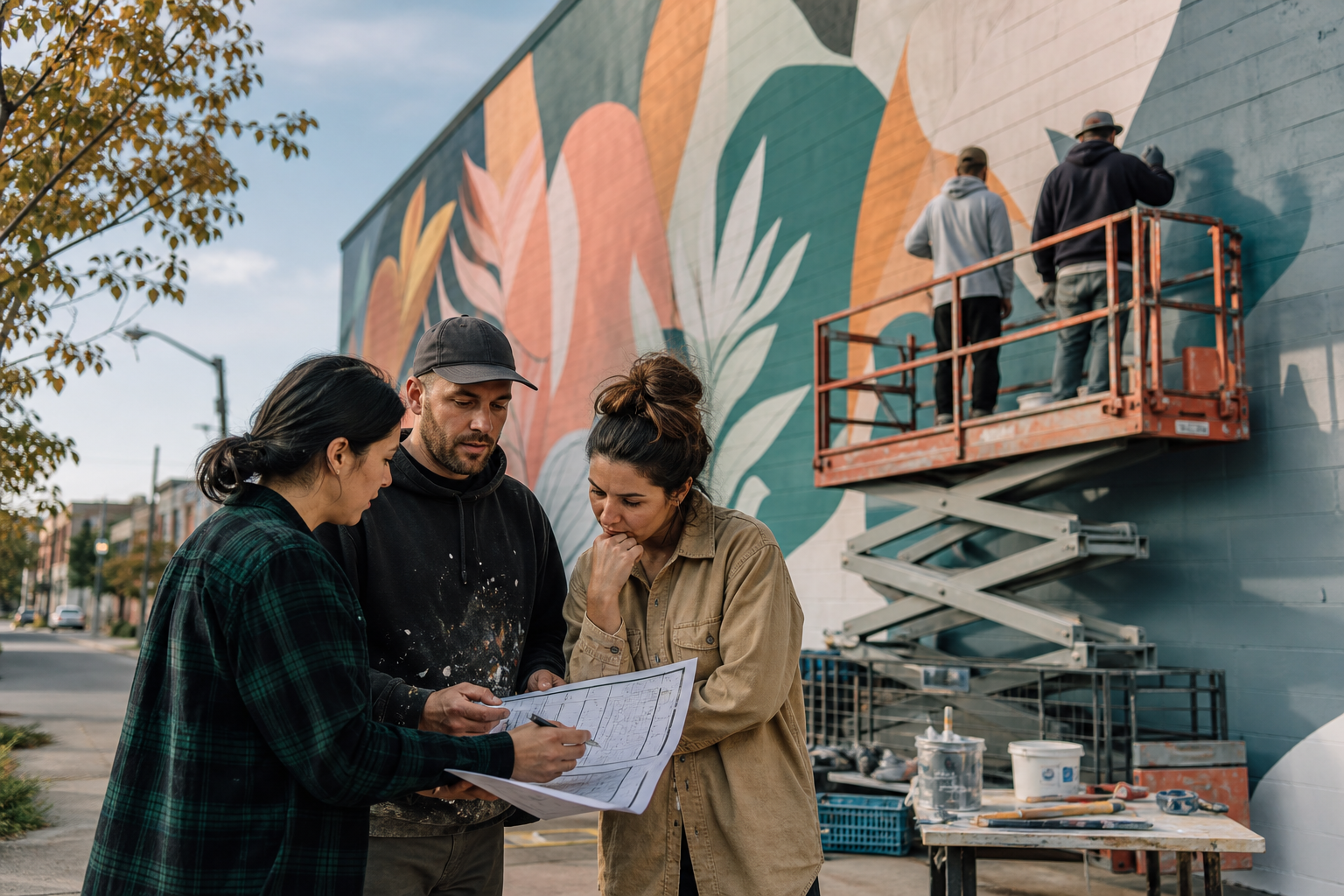
Common failures in site coordination for murals and how to avoid them
Avoid delays and costly rework by vetting site coordination for murals. Ask for permits, installation plans, mockups, insurance, and a risk register before.
Why site coordination matters for murals and direct-to-wall UV printing
Site coordination for murals is more than scheduling. Weak coordination increases the chance of schedule slips, surprise costs, and compromised finishes that damage brand presence. For direct-to-wall UV printing and high-resolution murals, coordination also governs surface readiness, colour calibration, and on-site equipment logistics. Ink Blend emphasises a four-step workflow from discovery to approvals and on-site printing to reduce these exact risks, so planning these items early will save time and money on reveal day (Ink Blend).
Top site coordination failures that add cost or risk
Below are the coordination failures that most often cause rework, delays, or liability exposure. Each item includes the practical consequence so you can judge proposals against real outcomes.
Unclear permit and approval ownership
Failing to assign permit responsibility creates delays, fines, or forced removals if municipal approval or landlord sign-off is required. Ask whether the vendor handles permits or whether you must obtain approvals. For outdoor or public-facing installations treat this as a live task in the project plan rather than an afterthought. See a client checklist for site visits that highlights permit questions and approvals to confirm before work starts (site-visit checklist).
No installation plan or method statement
If a proposal contains only dates and rough labour estimates it is treating coordination as scheduling rather than protection of the artwork and building. A formal installation plan or method statement defines access, containment, material handling, staging, and clean-up procedures. Project coordinators should produce an installation plan plus a short method statement showing how they will protect finishes and people during the install (project coordination services).
Surface readiness not scoped or priced
Surface preparation is a fundamental variable that determines cost and quality for both traditional paint murals and direct-to-wall UV printing. If surface issues such as texture, repairs, priming, or moisture are not scoped the finished artwork can show defects or bond failures. Define surface prep tasks and acceptance criteria up front and include them in the quote. Commissioning guidance separates surface prep from painting or printing scope to make responsibilities clear (how to commission a mural). For material guidance and interior expectations review the studio's custom murals guide (custom murals guide).
Inadequate access, scaffolding, or equipment planning
Surprise lift or scaffold costs are common when a vendor quotes without measurements or photos. A reliable coordinator will request photos, elevations, ceiling heights, and any fixed obstacles so they can specify lifts or scaffolding in the proposal. Ask whether a site visit is required for access planning and confirm who secures and pays for hire equipment to avoid last-minute extras (access and equipment checklist).
No mockups, scale checks, or colour calibration proofs
Skipping mockups guarantees surprises on reveal day. For direct-to-wall printing 4K artwork detail and colour-led production reduce risk but only if the process includes scaled mockups and colour proofs. Make mockups and a staged approval process contract deliverables so scale, composition, and colour are approved before printing or paint begins (mockup and approval guidance).
Poor documentation: no decision log or risk register
When issues arise the presence of a decision log and a risk register prevents disputes and repeated site visits. Project coordination that focuses only on the install date often leaves owners without records of scope changes, approvals, or contingency decisions. Request a lightweight decision log and a simple risk tracker so every change and who authorised it appears in writing (coordination deliverables).
Insufficient insurance, certificates, or method statements
Liability exposure increases when a vendor cannot provide insurance certificates, safety method statements, or subcontractor documentation. Demand up-to-date liability insurance certificates, worker safety certificates, and a written method statement for any high-risk access or lift use. If these documents are vague or unavailable treat that as a pricing and risk concern when comparing vendors (insurance and documentation).
Exactly what to ask vendors during vetting and pre-contract

Use this prioritised question list in a vendor interview or RFP to test whether a provider's coordination covers the risks above.
- Do you handle permits and approvals or will the client be responsible? Ask for recent examples where you secured municipal or landlord approvals.
- Will you perform an in-person site visit before quoting? If not, what photos and measurements do you require?
- Can you provide a sample installation plan, method statement, and day-of schedule specific to our wall?
- How do you document decisions and scope changes? Will we receive a decision log and a risk register?
- What surface preparation do you assume and how will you verify the wall meets printing or painting tolerances?
- Do you include mockups, scale checks, and colour proofs in the quoted price? How are approvals staged?
- Who provides and pays for access equipment such as lifts, scaffolding, or hoisting? Do you use certified operators?
- Can you share current insurance certificates and safety method statements for this project type?
- What contingency plan do you have for access, weather, or building schedule changes?
Documents and deliverables to demand before work starts
A competent coordinator will include these items as attachments to the contract. Make them conditions of payment and scheduling.
- Installation plan and site method statement describing staging, containment, access, and protection.
- Artwork list and final 4K files or print-ready proofs with colour profile notes.
- Scaled mockups and a sign-off record for composition and colour calibration.
- Signed permit copies or documented permit responsibilities and timelines.
- Decision log showing all scope changes with date and authorisation.
- Risk register or issue tracker with mitigation steps and contingency allowances.
- Insurance certificates and subcontractor documentation where applicable.
- Site-day schedule with contact names, access windows, and clean-up responsibilities.
How direct-to-wall UV printing changes coordination needs
Direct-to-wall UV printing requires explicit coordination items that do not appear in simple paint-only projects. Expect tighter surface tolerances, dust control during printing, an on-site printer footprint, and attention to curing and ventilation. The studio process should confirm 4K artwork detail and colour-led production during approvals so the final print matches the mockup. For more on material choices and surface expectations consult the custom murals guide to align finishing and preparation steps with UV printing needs (custom murals guide).
Local and building rules to verify early for Ontario projects

Ontario projects commonly require condo board approvals, landlord consent for leased premises, building access windows, and restrictions on noisy work hours. Clarify tenant and lease clauses about alterations and confirm whether building management requires proof of insurance or a site-specific safety plan. If the artwork faces public view ask early about municipal sign or public art approvals and treat permitting as part of the baseline timeline (permit checklist).
Vendor decision criteria and red flags
Use these criteria when scoring proposals. Treat any missing item as a negative point.
- Positive: Requires site visit or detailed photo set for quoting.
- Positive: Includes mockups, scaled proofs, and staged approvals in the price.
- Positive: Provides installation plan, risk register, and decision log templates.
- Red flag: Vague surface prep assumptions or no surface acceptance criteria.
- Red flag: No insurance certificates provided on request.
- Red flag: Refuses to commit to permit handling or to identify who will manage approvals.
- Red flag: Quote is time-bound but lacks a documented installation plan or method statement.
What to expect on print or paint day and how to limit disruption
On site day expect a short briefing with contacts, a staged approval at mid-point, containment zones, and a final handover record. Limit disruption by agreeing to a single client liaison, a defined access window, and a clean-up standard. Require the coordinator to produce a brief completion checklist and photographic handover showing the installed work and protected adjacent finishes (site handover checklist).
Next steps and a short vendor interview script
To act now collect clear photos and measurements of the wall, note access constraints and building rules, and run the vendor question checklist above. Use this short script in an initial call: "We need a photo-based quote and an installation plan that includes permits, mockups, and insurance certificates. Can you confirm you will provide a site visit or tell me exactly what photos you need?" If the vendor cannot answer each item or refuses to commit to documentation escalate that as a negotiation point or seek alternatives (vetting guidance).
FAQ
Who should be responsible for municipal permits and approvals for a mural project
Responsibility varies. Some mural providers handle permits as part of full coordination while others expect the client or property owner to secure approvals. Ask vendors directly and require permit ownership or a hand-off plan in writing so timelines and costs are clear (permit responsibility guidance).
How does direct-to-wall UV printing change the surface preparation and site coordination requirements
UV printing has narrower surface tolerances and needs dust control, accurate colour profiles, and on-site printer logistics. Surface repairs, priming, and acceptance criteria must be defined before printing. See the studio's approach to 4K detail and surface checks in the custom murals guide for practical alignment (custom murals guide).
What insurance and certificates should a site coordinator provide before work starts
Request commercial general liability insurance, proof of worker safety training for operators of lifts, and subcontractor certificates if applicable. A competent coordinator will supply these documents with the proposal or as a contract attachment (coordination deliverables).
Can a site coordinator limit disruption in an operating restaurant or retail store and how
Yes. Effective coordinators plan access windows, contain the work area, stage approvals, and assign a single client liaison. They also plan for off-hours work, quiet equipment, and a clear clean-up standard to protect operations and customers (site disruption checklist).
What is a decision log and why should I insist on one for a mural project
A decision log records scope changes, approvals, and who authorised each change. It prevents misunderstandings and supports faster resolution of issues without repeated on-site visits. Insist on it where scope or access decisions could affect cost or schedule (decision log guidance).
Ink Blend offers photo-based quotes, mockups, and coordinated installs across Ontario, and you can request a quote and an installation plan on the website.