
What should you ask before choosing wall murals Canada?
Avoid costly surprises: a red-flags checklist for choosing wall murals Canada, with verification steps, a pre-quote photo and measurement checklist.
How to use this red‑flags checklist
This article is a practical gatekeeper you can use during early vendor conversations and when reviewing written quotes. Read each red flag as a stop or go question. If a vendor cannot show the verification step that follows a red flag, treat it as a reason to pause and request evidence. Ink Blend positions direct‑to‑surface UV printing as a premium, mockup‑led service that reduces many of the risks below, so you can use these checks to compare any studio to that standard (see the studio overview at the company website for reference).
Top red flags that should stop a project in its tracks
Below are the highest risk warning signs, each followed by a single verification step you can request immediately. Use these to triage proposals during the shortlisting stage.
No mockups or scale visual approvals
Why it matters: A mural that looks right on a screen can read very differently on a 10 foot wall. Without a scaled mockup you risk disproportionate elements, awkward cropping, and colour relationships that break the design.
Ask for: a scaled mockup that places artwork into a photo of your wall, annotated with element repositioning notes and scale marks. Insist on the ability to request repositioning, crops, or a second mockup round before any work begins. Premium studios typically include this step as part of concept and approvals.
No surface‑preparation plan or inspection report
Why it matters: Surface defects such as poor plaster patches, textured paints, moisture stains, or existing wallpaper will affect adhesion, finish, and durability of both printed wallpaper and direct prints.
Ask for: a written site inspection or surface checklist that lists remediation obligations, who carries out repairs, and any extra costs. A proper vendor will describe expected prep steps and offer a written plan for remediation or confirm that no remediation is needed.
No colour proof or explanation of colour shifts
Why it matters: Printing processes can produce colour differences due to inks, substrates, and local lighting conditions. Without a proof you face surprises on tint or contrast in situ.
Ask for: a physical sample patch or digital colour proof with the vendor’s colour management notes, plus a site lighting check so you can review the proof under the wall’s actual lighting. Ask how illumination will change perceived colours and what the vendor’s remedy is for visible shifts after installation.
Vague intellectual property or usage rights
Why it matters: Artwork rights determine who can reproduce, photograph, or reprint the mural. Vague wording can create downstream legal problems if artwork is licensed, uses stock images, or includes third party branding.
Ask for: clear contract language that explains who owns final artwork files, what reproduction rights you receive, and whether the vendor holds any reuse rights. Request written confirmation that licensed or commissioned artwork has the proper permission for commercial display and reproduction.
Quotes without exact dimensions or annotated site notes
Why it matters: Estimates based on rough areas or verbal descriptions are unreliable because small measurement differences change material needs and labour significantly.
Ask for: a photo‑ and measurement‑based quote that lists exact wall width, height, and any tolerance assumptions. Many suppliers require exact dimensions to produce a quote and will accept photos with scale references, as some wallpaper providers explain when they ask for exact wall dimensions during ordering.
No site coordination or disruption plan
Why it matters: On‑site work can disrupt operations in hospitality, retail, or office spaces. Poor coordination leads to missed access windows, safety incidents, and messy handoffs.
Ask for: a site coordination plan that names an on‑site contact, lists working hours, describes noise and dust control measures, and explains the reveal and handoff procedure. The vendor should confirm insurance coverage and crew conduct expectations for working in occupied spaces.
Thin portfolio or missing before and after examples for similar spaces
Why it matters: A vendor’s work in a small residential room does not guarantee success on a large hospitality feature wall. Portfolio relevance and before and after examples reveal finish quality and installation care.
Ask for: examples of projects at similar scale and industry, and ideally before and after photos that show how the vendor addressed prep and finishing. If a studio cannot show relevant work, request client references for similar projects.
Wallpaper mural or direct‑to‑wall UV printing: format specific red flags
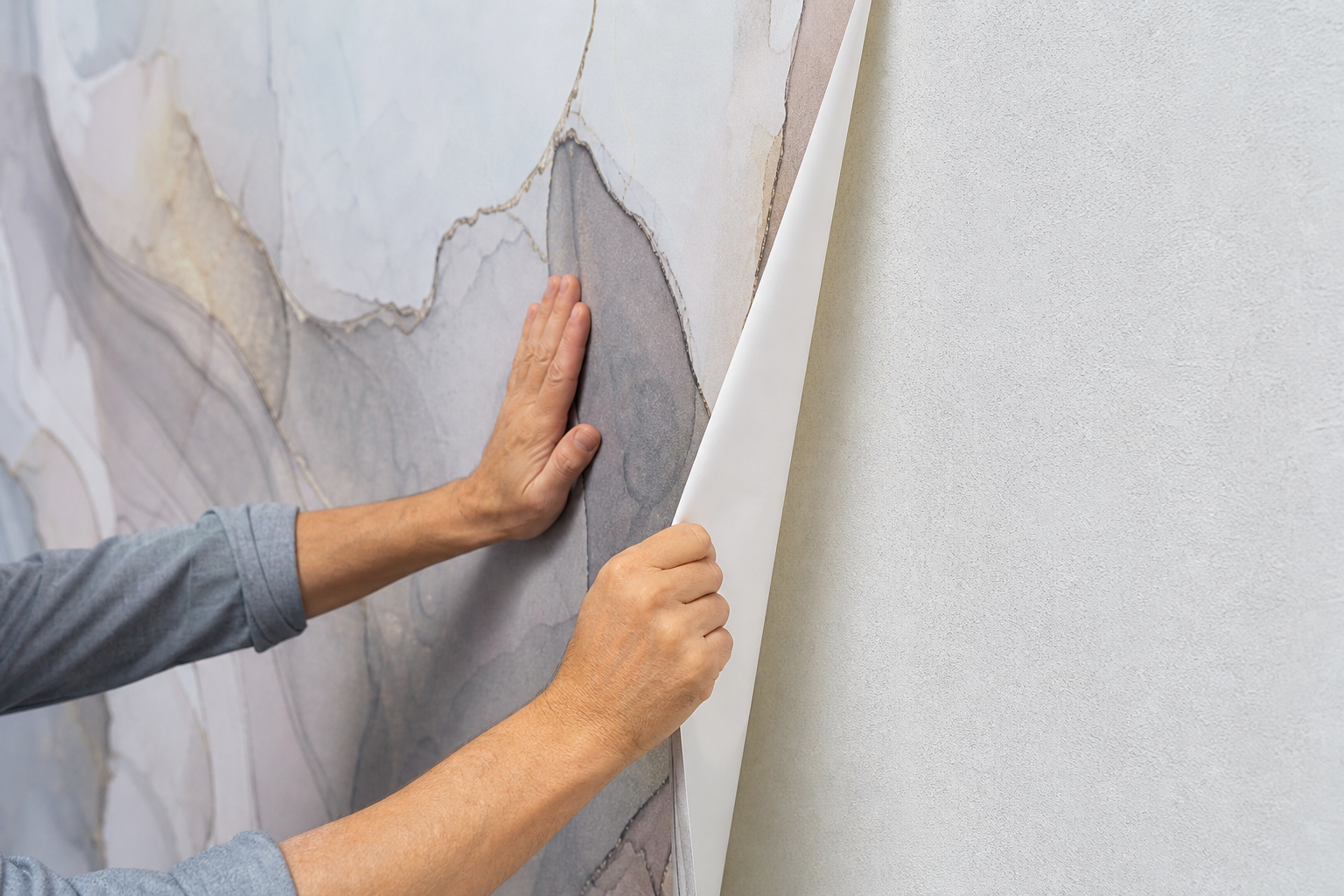
Two common approaches are printed removable wallpaper and direct‑to‑surface UV printing. Each has format specific weaknesses to check for before you decide.
When wallpaper murals raise red flags
Common issues: poor seam alignment, installation mistakes, removal damage, and substrate incompatibility. Wallpaper is an image printed onto a substrate and installed as panels, so fit and installation quality are critical.
Verification steps: Confirm whether the provider offers professional installation, what guarantees they have for seams and pattern repeat, and whether they provide a custom size option to avoid awkward cropping. For vendor guidance on sizing and installation, see a wallpaper mural provider FAQ such as the one that explains custom sizing and local installation options at About Murals or the ordering notes at Muralls.
When direct‑to‑wall UV printing raises red flags
Common issues: adhesion failure on poorly prepared surfaces, inadequate masking around trims and fixtures, and lack of patch testing. Direct prints deposit inks onto the wall itself and rely on good surface preparation and compatible inks.
Verification steps: Demand a surface adhesion check, a small test swatch when possible, and a written surface preparation plan. Ask about expected finish and whether the vendor will perform a test patch during mobilization. Studios that specialise in direct printing typically outline a workflow of discovery, mockup, and on‑site printing as part of their service description.
Pre‑quote photos and measurement checklist you can use now
Send this exact set of photos and notes to vendors for a fast, accurate quote. Vendors that accept photo‑based quotes should request these same items.
Photos to take and how to label them
- Full wall, centred: one straight on photo of the full wall with a tape measure in view for scale, labelled "Full wall - width x height".
- Left and right corners: show adjacent walls and junctions, labelled "Left corner" and "Right corner".
- Close details: texture, existing repairs, trims, outlets, and fixtures, labelled "Texture - detail" and "Trim - detail".
- Context shots: show furniture, counters, and circulation paths that will sit near the mural, labelled "Context - neighbouring elements".
- Lighting: daytime and evening photos of the wall under normal lighting, labelled "Light - day" and "Light - night".
Measurements and site notes to include
- Exact width and height in centimetres and metres, plus ceiling height.
- Distance to nearest obstructions such as columns, doors, and windows.
- Surface description: drywall, plaster, concrete, painted, textured, damp, or previously wallpapered.
- Operational constraints: working hours, after hours access, or required weekend work.
- Contact name, phone, and building entry instructions for a site visit if needed.
Several mural vendors stress exact wall dimensions and scale when accepting orders, so including these fields speeds quoting and reduces guesswork.
Local considerations for projects in Ontario and Canada
When you plan projects in Toronto, Mississauga, Brampton, Vaughan, Markham, Oakville, Hamilton, or Kitchener, check whether the vendor lists those service areas and whether they use local installation partners. If you need a local point of contact, ask for a verified business address or local reference, because a listed address helps with permitting and emergency coordination. For a regional example of project pages and local guidance, review a specialist studio case page such as custom wall murals Canada Brampton.
Questions to ask about local scheduling and permits
- Do you provide after hours installation to avoid business disruption?
- Do crews carry proof of insurance and WSIB coverage for Ontario jobs?
- Who signs the final acceptance, and what is your snags and defects process?
Real objections and the decision criteria that matter
Owners often push back on cost, permanence, maintenance, and disruption. Use this shortlist of decision criteria to weigh those objections against brand protection.
- Risk reduction: mockups, proofs, and a surface plan reduce the chance of an expensive rework.
- Longevity versus flexibility: wallpaper is removable, direct prints are permanent. Choose based on your need for future redecoration.
- Operational disruption: a clear site plan and after hours options limit business impact.
- Visual accuracy: colour proofs and lighting checks protect your brand colours and photography workflow.
Next steps: what to request on the quote and a downloadable checklist
When you ask for quotes, attach a one page checklist that includes exact dimensions, photos labelled as above, a mockup request, a surface inspection clause, a proof or sample patch, and a statement of artwork rights. Vendors who are comfortable operating at a higher standard will provide these items in writing.
If you want a local studio that provides photo based quoting, mockups, 4K artwork detail, and direct‑to‑surface printing options, include your labelled photos and measurements when you request a quote. For professional direct‑to‑surface UV printing, mockups, and photo quoting, contact Ink Blend?
Frequently asked questions
How do I tell if a mural vendor will produce accurate colours under my lighting?
Request a physical colour proof or a small sample patch printed in the vendor’s production process, and review it on site under both daytime and evening lighting. Ask the vendor to describe their colour management workflow and what remedies they offer if visible shifts appear after installation.
What should be included in a written quote for a wall mural project?
A complete quote should list exact wall dimensions, surface condition notes, scope of surface preparation, mockup rounds included, colour proof or sample patch, installation or on site printing details, warranty or remedial commitments, a schedule and site coordination plan, and clear wording about artwork rights.
Can direct‑to‑wall UV printing be removed later without damage to drywall?
Direct printing is designed to be durable and permanent, so removal typically risks damage to the substrate. If you anticipate future removal, discuss removability up front and consider removable wallpaper as an alternative. A vendor should clearly explain permanence and removal risks during the proposal stage.
What photos and measurements speed up an accurate mural quote?
Send a straight on full wall photo with a visible tape measure for scale, left and right corner shots, close texture details, lighting photos for day and night, and exact width, height, and ceiling height in centimetres. Include notes about nearby furniture and access constraints.
Who owns the artwork and usage rights after a custom mural is printed?
Ownership depends on contract language. Ask for a written clause that defines who retains original art files, whether you receive reproduction rights, and whether the vendor retains any usage rights. Clarify permissions for third party photography and promotional use before work begins.
Talk with Ink Blend
Contact Ink Blend to ask about the next step and confirm which options fit your needs.